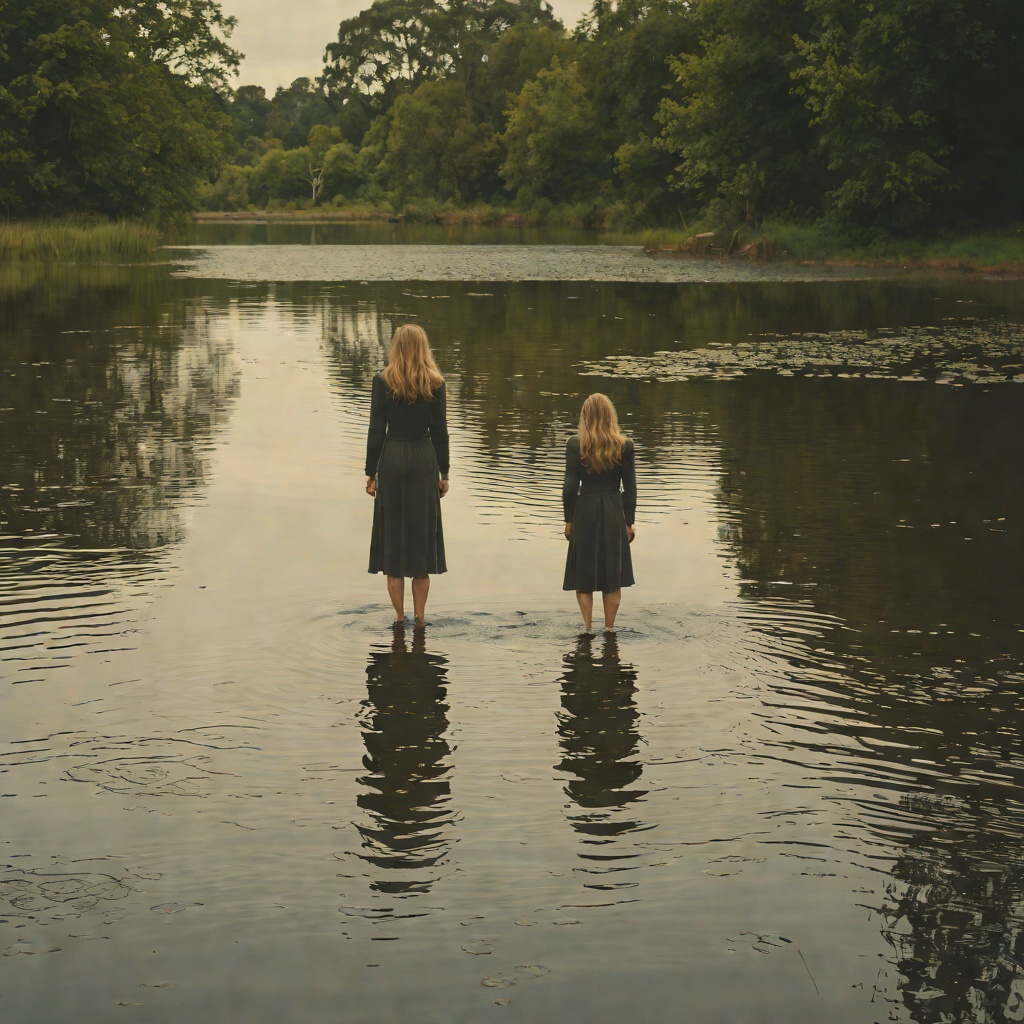
Maddie Schwartz
Lady in the LakeMaddie Schwartz begins the novel as a woman defined by her household and her marriage, priding herself on being unflappable and running her home with a sly wit and effortless organization. She is married to Milton Schwartz, a man who has become a big shot, and she lives in a beautiful house in North Baltimore, where she manages domestic miracles by spending freely—Milton's shirts go to the best laundry in North Baltimore, a cleaning girl comes twice a week, and her famous yeast rolls come out of a can. She hosts ambitious parties, including a New Year's Day open house for Milton's law firm colleagues and a spontaneous spring party so successful they feel obliged to keep having it. Yet beneath this polished surface, Maddie is restless, and her restlessness will soon shatter the life she has so carefully constructed.
Leaving the Marriage and the Ring
Maddie's break from her old life begins with a decision to sell her engagement ring, and it is only when the jeweler puts his loupe to his eye that she realizes she has already mentally spent the money. She hopes for a thousand, maybe even two thousand dollars, because she needs so much. She has moved into a two-bedroom apartment on Gist Avenue, sparse on furnishings, having assumed her son Seth would live with her. But Seth refuses, saying he would rather stay with his father in the Pikesville house, near his friends and his school, even after she offers to drive him to school. Maddie suspects Milton's meddling, and comforts herself with the knowledge that Seth has only two years left at home. She would have chosen a one-bedroom in a better neighborhood if she had anticipated Seth's resistance, and then she might actually have a phone—although not having a phone isn't completely tragic, since it means her mother can't call her every day to discuss Maddie's future and what Tattie Morgenstern unfailingly calls her reduced circumstances. The apartment itself feels alien: no Seth, so little furniture, and neighbors who snub her as if she were the undesirable one in this neighborhood of maids and laundresses, milkmen and streetcar conductors. One evening, on what she wants to believe is an impulse, she takes her engagement ring and shoves it deep into the dirt of a potted African violet she keeps on a rickety table near the patio door, then methodically creates the appearance of chaos by opening drawers in the kitchen and bedroom and tossing some of her clothes to the floor. This staged burglary will bring her into contact with Ferdie Platt, the Negro cop who responds to the call, and whose presence in her life will become far more significant than either of them anticipates.
The Path to Journalism
Maddie's transformation from housewife to reporter is catalyzed by her discovery of the body of Tessie Fine, a young Jewish girl murdered in a tropical fish store. As the first person to see Tessie dead, Maddie feels connected to the girl's father, Stephen Corwin, the last person to see her alive. She writes him a letter on simple cream vellum, bought from a stationer's on Charles Street, covering it with her fine, bold handwriting: "Dear Mr. Corwin, I am Madeline Schwartz, the woman who found the body of Tessie Fine. As a result, I feel connected to you, for better or worse. You were the last person to see her alive, I was the first person to see her dead." She walks to the main post office to make sure it will be delivered as soon as possible, and it never occurs to her that he might not write her back, because men almost always do what Maddie wants them to do—almost. This letter marks the beginning of her correspondence with Stephen Corwin, and it is the first step in a career that will define the rest of her life. She eventually parlays her involvement in the case into a job at the Beacon, where she starts as a general assignment reporter, goes on to cover city hall and the legislature, and becomes best known for her work in the Living section, first as a reporter of human-interest stories, then as a columnist. In 1979, she is a finalist for the Pulitzer Prize in feature writing.
Relationships and the Cost of Ambition
Maddie's relationships are marked by a pattern of using people as means to her own ends, even as she genuinely cares for some of them. Her friendship with Judith Weinstein begins when Judith invites her to a meeting at the Stonewall Democratic Club, suggesting it's a good way to meet people in an open governor's race year. Judith, who is trying to get out of her parents' house without marrying first, sees Maddie as her best chance to do so, sizing her up from the moment she tries to sell her engagement ring as if she couldn't care less how much money she gets for it. Maddie, for her part, risks a tremulous smile at Judith's kindness, reflecting that kindness can be so much more painful than cruelty, and writes her mother's number on the back of a cash register receipt from Rexall. Her relationship with Ferdie Platt is more complicated. When he tells her he loves her, she thinks that it is illegal because he is black, but impossible because he is younger, because he is a cop and she is Madeline Morgenstern Schwartz and she isn't going to be a newspaper clerk forever. She could go out in public with a black man of stature—Sidney Poitier, Andrew Young, Harry Belafonte Jr.—but Ferdinand Platt is impossible on many levels, and race is only one of them. Ferdie tells her that his happiest day of the past year was going to a ball game with her, even though he couldn't hold her hand or put his hand at the small of her back as they moved through the crowd, and that he was so proud to be with her. But Maddie's ambition ultimately costs him his dream of becoming a detective, a loss that haunts her for decades.
The Legacy of the Lady in the Lake
Maddie's most profound and troubling relationship is with Cleo Sherwood, the woman whose death she investigates and whose story she turns into her own beginning. Cleo, speaking from beyond the grave, accuses Maddie directly: "You came in at the end of my story and turned it into your beginning. Why'd you have to go and do that, Madeline Schwartz? Why couldn't you stay in your beautiful house and your good-enough marriage, and let me be at the bottom of the fountain? I was safe there." Cleo notes that everybody was safer when she was there. Yet Cleo also reveals that Maddie was the last person who saw her alive—the actual her, Eunetta "Cleo" Sherwood—not Tommy on New Year's Eve, although that will always remain the official story. It was Maddie, in her hospital bed, ten months later, too groggy and overwhelmed by her own drama to pay close attention to Cleo's. Cleo walked out of that hospital and said goodbye to Cleo Sherwood forever, saying goodbye to her parents, her babies, and Baltimore, but not to life or to love. By the time of Maddie's speech at the Woman's Club of Roland Park in October 1985, she has written the Star out of her official history, taking her first-person near-death story about Angela Corwin and parlayed it into a job at the Beacon, never looking back. She is a grandmother now, not atypical for a woman about to turn fifty-seven, and she still looks good. Wallace Wright, recently out of marriage number two, has asked her for a date, and she turned him down, saying she was seeing someone—a forty-year-old gardener who comes to her apartment, and who is very much like the arrangement she had with Ferdie, but with different drinks and snacks. She also has a daytime arrangement with a pompous old judge, almost certainly gay, who requires a presentable companion at times. At the end of her speech, she asks herself, "Where am I, Maddie Schwartz?"—a question that echoes Cleo's own haunting of her, the dead woman who still talks to her in her head all these years later, because Maddie was the last person who saw her alive. Cleo's final question to Maddie is whether she can say the same thing—that she wouldn't do anything differently—and the novel leaves that question hanging over Maddie's legacy, a woman who built a career on another woman's tragedy, who turned a dead girl's story into her own beginning, and who must live with the knowledge that her ambition came at a cost she can never fully repay.